Article
Why Measuring Building Performance Could Transform Housing Policy
Billions of pounds of public money, fuel poverty support and retrofit decisions depend on Energy Performance Certificates (EPCs). But what if those certificates can't reliably identify which homes actually lose the most heat?

A major new study, the largest of its kind, led by the Energy Saving Trust in collaboration with Build Test Solutions and the Department for Energy Security and Net Zero, has exposed a significant blind spot in how we assess building performance. In-situ measurement of homes’ heat loss is compared with that predicted when producing an EPC.
Previous studies generally involved 20–30 homes and were often limited to new-build housing. This study examines more than 500 homes across a broad cross-section of the housing stock, providing the strongest evidence yet of how predicted and measured thermal performance differ in practice.
The results are remarkable:
- EPC estimates were effectively correct for less than half (44%) of the homes surveyed
- Measured heat loss varies surprisingly little with building age
- There is substantial variation in measured heat loss in every EPC rating band
- Measured performance was better on average than predicted, meaning the retrofit challenge may not be as costly or difficult as previously thought
This is not just a technical quirk for industry experts; it is a public interest issue. Misrepresenting how buildings perform has a direct impact on the nation’s health and the public purse. According to the report, poor-quality housing costs the NHS approximately £1.4 billion annually in direct costs, a figure that balloons to £18.5 billion when wider societal impacts are included. By relying on estimates rather than reality, we are effectively flying blind. Better assessment won't eliminate poor housing itself, but it would dramatically improve our ability to identify the homes causing the greatest health impacts and prioritise investment where it delivers the greatest benefit.
For families living in homes that are colder than anyone realises, better measurement could mean getting help sooner rather than being overlooked because their home appears acceptable on paper.
The "Average Trap"
The problem lies in how the current system views a house. It assumes that homes that look the same perform the same. The reality is much messier than that. Each building is a unique system of materials, and details of how they fit together make critical differences. Is there insulation in a cavity wall, and if so, how much? How well are draughts eliminated around windows, doors, and pipework? Has loft insulation been interrupted to fit new spotlights?
Because the EPC system relies on a small set of ‘typical’ assumptions, it produces a narrow performance profile. In simple terms, it assumes that homes are clustered around an average. Consequently, the system fails to differentiate the very best homes from the very worst. It effectively hides the coldest, most vulnerable homes within a sea of "average" results. Across more than 500 homes, the study found substantial overlap between measured heat loss in properties spanning multiple EPC bands and construction eras.
While newer homes performed slightly better on average, building age and EPC ratings explain surprisingly little of the variation in measured performance. This suggests that compliance with design standards alone is not enough to guarantee outcomes in practice. The real goal is not simply better energy ratings, but lower energy consumption, lower bills, reduced emissions and warmer homes. To reach our true goal, paper requirements must be matched by measured quality assurance.
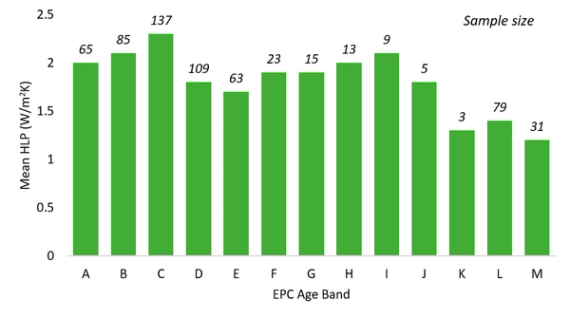
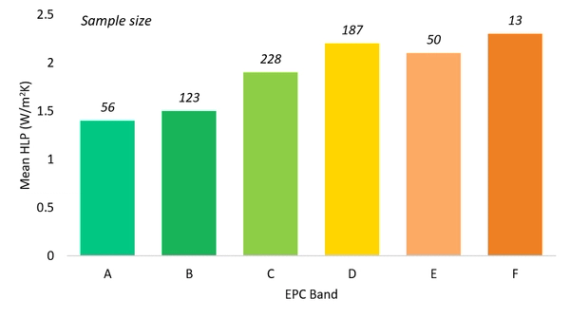
More widely, the poor correlation between assumed and actual performance suggests a knowledge gap: we simply don’t know what building materials and processes deliver real results. This knowledge gap can only be addressed by measuring what works and what doesn’t, and using this to inform feedback to design and construction practices.
Unexpected thermal performance should prompt questions. Whether that's missing insulation, excessive air leakage or conditions that increase the risk of cold, damp and mould, better measurement helps identify homes that deserve closer investigation.
Moving from Paper Performance to Precision
The results do not show that EPCs are useless. Rather, they show a clear correlation between EPC-assumed and measured heat loss, but a poor correlation. This means that the system is delivering to its intended outcome, with typical performance for house types categorised from worst to best performing.
The issue is that EPCs are increasingly being used for decisions that require accuracy at the level of individual buildings. For those applications, assessing typical performance is no longer sufficient. For key decisions like which households are at most risk of fuel poverty, which buildings most require retrofit to reduce energy demand and emissions, or quality assurance of new build and retrofit works, assessment of typical performance just doesn’t work.
The report concludes that advances in technology mean that heat loss measurement is now practical at scale in occupied homes, overcoming previous barriers of disruption and cost. Heat loss measurements have recently been standardised in CIBSE TM71, creating a clearer framework for consistent industry adoption and future regulatory consideration.
When applied to the housing stock, the potential impact is staggering. EPC C remains a common building performance target in policy and industry. Using EPC C as an illustrative benchmark, the study estimates that around 3.2 million homes currently rated below Band C would move to Band C or above if measured performance were used, while around 1.5 million homes currently at Band C or above would move below the threshold.
A Roadmap for Retrofit
By integrating HTC measurement into our policy toolkit, we can turn a blunt instrument into a precision tool. This would allow us to:
- Target the coldest homes: Focus funding on the properties that are genuinely performing worst, rather than those that just look worst on paper.
- Verify quality: Move from hoping for savings to verifying them, holding the retrofit supply chain accountable for actual outcomes.
- Optimise investment: For social housing providers and green finance lenders, measurement provides a clear, data-driven path to determine which measures, whether solar, heat pumps, or fabric upgrades, will actually lower bills for residents.
- Feedback and continuous improvement: Apply established manufacturing good practice to construction to understand which materials, designs, and processes deliver the best outcomes.
For nearly twenty years, EPCs have helped benchmark the UK's housing stock. The next stage isn't to replace them, but to complement them with measurement. The opportunity is to move from estimating performance to measuring it, and to use that knowledge to spend public money more effectively, improve health outcomes and accelerate the path to net zero.