Case Study
Data-Driven Retrofit: How Measured Heat Loss Slashed Heat Pump Sizing & Costs for a 1930s Home
In this case study, we look at how Your Energy Your Way used BTS’s SmartHTC and Heat3D technology to challenge "worst-case" estimates and deliver a perfectly sized heat pump system for a detached home in Surbiton.
Key Takeaways:
- Actual heat loss was much lower than calculated
- A key difference was that the solid walls performed better than standard assumptions
- Smaller heat pump (8kW, not 12kW)
- 5 planned radiator changes weren’t necessary
- Thousands of £s saving and lower disruption
The Challenge: How "Solid" is that Wall?
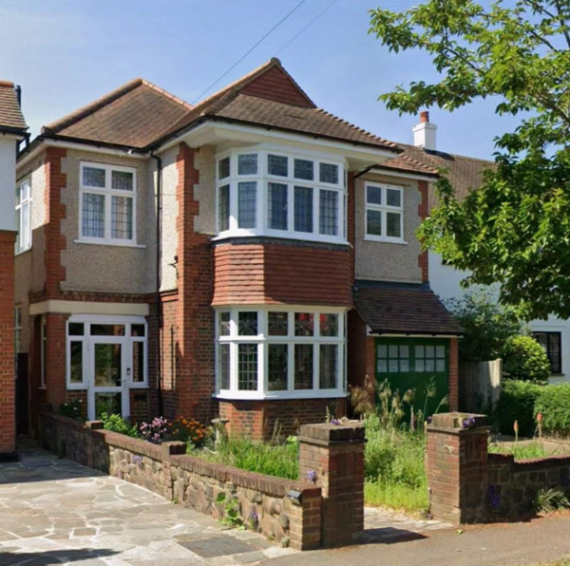
This 1930s detached home in Surrey presented a classic retrofit dilemma. The property featured a mix of original solid brick walls and a newer, insulated rear extension.
When Your Energy Your Way (YEYW) conducted a standard room-by-room heat loss calculation using theoretical U-values, the figures suggested a total heat loss of 12kW. For a heat pump installation, this would have necessitated a large, expensive unit and significant upgrades to internal radiators and pipework, adding thousands to the project cost.
However, Leah Robson and her team at YEYW suspected the house was performing better than the textbooks suggested.
The Solution: From Assumptions to Measurements
To get to the truth, YEYW moved away from estimates and deployed Build Test Solutions tools:
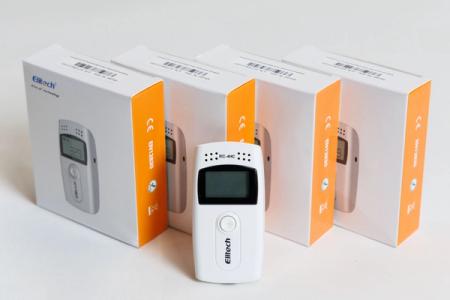
- SmartHTC (Thermal Performance Assessment): By installing data loggers throughout the property for a month during the heating season, the team tracked internal temperatures against energy consumption. This provided a real-world Heat Transfer Coefficient (HTC - the rate of heat loss during winter, per degree temperature difference between inside and out) for the entire building.
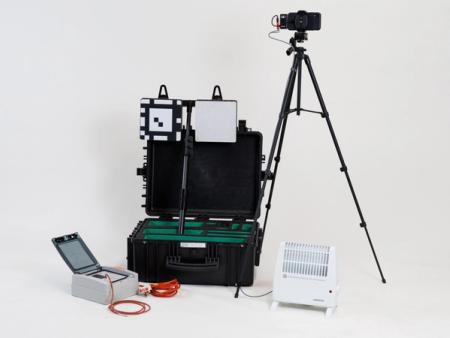
- Heat3D (In-situ U-value Testing): To understand exactly why the calculations were off, BTS’s Richard Jack carried out a U-value measurement using Heat3D.
The Results
The measurement data was transformative. The SmartHTC assessment revealed that the home’s actual heat loss was approximately 7kW, nearly half of the 12kW theoretical estimate.
The Heat3D wall measurements provided the "why." It turns out that the solid walls had much less heat loss than usually assumed, with a U-value of 1.2W/m2K compared to a typical assumption of 1.7W/m2K. One common reason for this difference is air gaps in a ‘solid’ brick wall created by things like "frogs" (indents) in bricks or small gaps between leaves of brickwork, which all create pockets of trapped air. These air pockets act as additional insulation, significantly slowing heat transfer. The size of these gaps is really variable between walls, and leads to apparently similar walls having very different performance.
Impact: Precision Sizing, Better ROI
Armed with accurate data, YEYW was able to redesign the system with confidence:
- Downsized Heat Pump: Instead of a 12kW unit, an 8kW Samsung R290 Monobloc was installed.
- Reduced Capital Costs: The smaller heat pump saved the homeowners significant upfront costs on the unit itself.
- Minimal Disruption: Because the heat loss was lower, five planned radiator upgrades were deemed unnecessary, preserving the home's period aesthetics, reducing installation time and disruption, and providing another major capital cost reduction.
- Optimised Efficiency: Sizing the heat pump to the actual load ensures it runs in its most efficient range, avoiding the "cycling" issues common with oversized systems.
A Future-Proofed Home Today, the home is a model of integrated renewable technology, featuring the 8kW heat pump, a 10-panel solar PV system, and 16kWh of battery storage.
"The whole-home assessment made us feel understood. It wasn’t just about installing stuff - it was about getting the house right first." Homeowner
The BTS Takeaway
This project perfectly illustrates why we advocate for "measure, don't guess." By using SmartHTC and Heat3D, installers can move away from conservative, "safe" estimates that penalise homeowners with oversized systems. Real-world data doesn't just improve performance - it makes the financial case for heat pumps much stronger.