Case Study
Party Planning Issues: Uncovering the Performance Gap
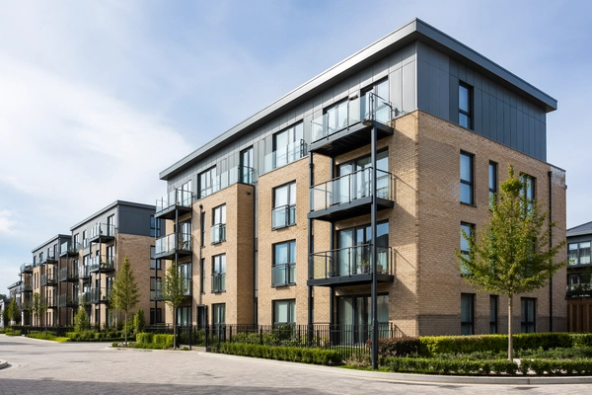
Build Test Solutions was commissioned to measure the as-built performance of ten apartments within a newly developed medium-rise complex where there had been complaints of high bills and cold homes.
To capture a full picture of the building's performance, the assessment combined three measurements:
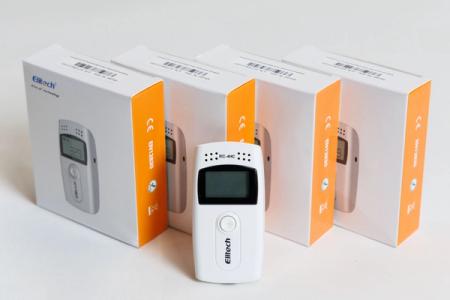
- SmartHTC to measure the overall Heat Transfer Coefficient (HTC)
- Pulse to measure air infiltration
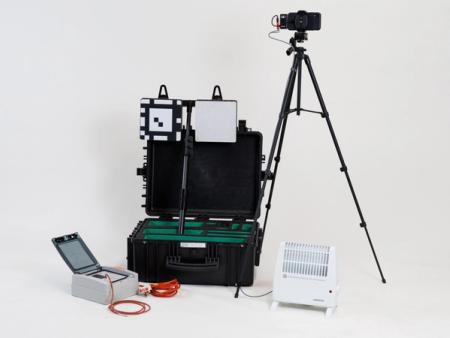
- A combination of Heat3D and heat flux plates to measure the U-values of external walls, internal walls, intermediate floors, and ceilings.
The Challenge: A Mysterious Performance Gap
Initial testing revealed a significant underperformance across the board. The SmartHTC measurements recorded total heat loss values ranging from 126 to 217 W/K, representing an average of three times more heat loss than the initial design SAP (Standard Assessment Procedure) calculations predicted.
Usually, a performance gap of this magnitude points to leaky building fabric or poor insulation. However, Pulse testing and U-value measurements demonstrated that the airtightness and heat loss through external elements were in line with design expectations.
The Discovery: The Party Wall Issue
The breakthrough came when measuring the internal surfaces between apartments. In the design SAP for the building, they were assigned a U-value of 0, meaning that it was assumed there would be no heat transfer between apartments. One of the underlying assumptions here is that the apartments will be at roughly similar internal temperatures, so that there’s little temperature difference to drive heat transfer.
The measurements told a different story. The data showed consistently significant heat flux through all of the measured party surfaces (party walls, floors, and ceilings), with measured U-values for these internal walls of 0.65 and 1.25 W/m²K. Amazingly, the heat flux measured through the party surfaces was actually larger than through the external surfaces, marking the biggest departure from the design performance.
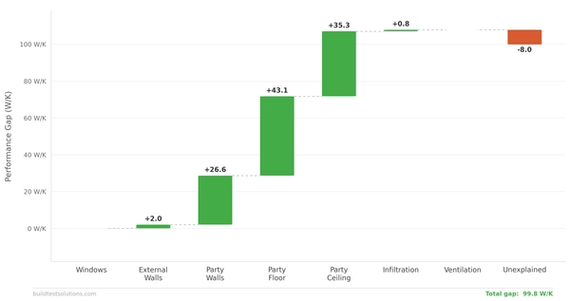
The measurements told a different story. The data showed consistently significant heat flux through all of the measured party surfaces (party walls, floors, and ceilings), with measured U-values for these internal walls of 0.65 and 1.25 W/m²K. Amazingly, the heat flux measured through the party surfaces was actually larger than through the external surfaces, marking the biggest departure from the design performance.
The Cause: Partial Occupancy
To check that this was heat transfer between apartments, rather than a thermal bypass to outside, heat flux measurements were conducted while adjacent apartments were heated to the same temperature, which showed close to zero heat transfer.
This meant that the root cause of the significant underperformance was that the building was partially occupied, with unoccupied apartments unheated. As a result, there was significant heat transfer from the occupied apartments to those that were vacant, causing the high bills and inability to heat to the desired levels.
A Wider Industry Issue?
This is not an isolated incident. Across several recent BTS projects, similar unexpected heat loss pathways through party surfaces have been identified. While partial occupancy was the cause in this case, the other projects revealed thermal bypasses to the outside, with party floors and ceilings comprising service voids proving to be particularly problematic. This could suggest a wider industry issue with heat loss through party surfaces in new buildings, which have perhaps only been suspected in older buildings so far.
Key Learnings for the Industry:
- The Reality of Partial Occupancy: While SAP calculations assume a U-value of zero for party walls, residents in partially occupied buildings may experience higher-than-expected heating bills as their heat bleeds into adjacent empty, unheated units.
- Pay Attention to the Party: Party surfaces can contribute a significant proportion of heat transfer, and cause issues with resident satisfaction and high energy use, meaning their design and construction should be considered as carefully as external surfaces.
- The Power of Measurement: Standard visual inspections or design models cannot account for these complex real-world dynamics. Using comprehensive measurement technologies like SmartHTC, Pulse, and Heat3D allows us to move beyond assumptions, diagnose exact causes of heat loss, and validate that a building's fabric is fundamentally sound.