Article
Rigour & regulation: Shaping the future of building performance in Paris
Theoretical models can only take us so far. If the building sector is going to hit true net-zero targets, the industry has to move away from standardised assumptions and start focusing on real-world, in-situ measurements.
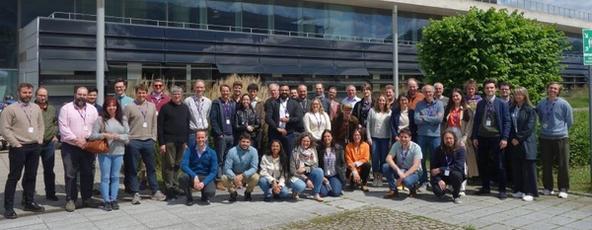
This was the driving theme behind a busy three days in Paris, which brought together the International Energy Agency (IEA) EBC Annex 94 cohort and broader European policy leaders.
The trip kicked off with two days of intensive working sessions. Now a third of the way through our work with this global collaboration, the focus is firmly on harmonising, standardising, and polishing heat loss coefficient (HTC) measurement methods to make them ready for mainstream industrial and regulatory adoption. One of the key goals is to extend the tools to be able to used in warm climates where cooling is prevalent, beyond the existing tools for heat loss measurement.
Looking to the next generation of building diagnostics
Going one step beyond, BTS’ Technical Director, Dr Richard Jack, is co-leading a subtask alongside Grant Henshaw from the University of Salford’s Energy House Labs. An emerging discipline where the aim is to efficiently determine the causes of unexpected performance to determine the best remedial works and inform feedback loops that improve quality over time. The team have designed a pathology process inspired by medical best practice that will underpin an open access method, and have started to build and AI-powered chatbot that can help residents understand their own building issues, powered by expert building physics. Things are coming together well, and there’s great potential for impactful outputs.
After 2 days of deep technical discussion, for day 3 the boffins looked outwards to think about how these measurement tools can best be used in practice through a symposium co-hosted by the French Scientific and Technical Center for Building (CSTB) and Mines Paris. The symposium brought together regulators, international experts, researchers, and field practitioners to discuss how best to take advantage of in-situ measurements as they reach maturity, and how their use interacts with the evolving Energy Performance of Buildings Directive (EPBD) across Europe.
The sessions and cross-border roundtables brought the immediate risk of inaction into sharp focus, highlighted by two key takeaways:
- Optimising consumption, not just compliance: Frank Klinckenberg from the Dutch Interior Ministry summed it up perfectly, the ultimate goal is to reduce energy consumption and costs, and not to optimise EPC ratings on paper.
- The cost of poor performance: Crucial data shared by the CSTB quantified the staggering financial and structural costs that poor building performance inflicts on the housing sector when left unmeasured.
For the Build Test Solutions team, the big challenge ahead is a clear one: ensuring our measurement tools continue to deliver these vital insights with absolute clarity, without sacrificing the scientific rigour that makes them reliable. We need to make the data digestible so that public bodies and practitioners can confidently integrate HTC testing into future building policies.
Want to start diagnosing your building?
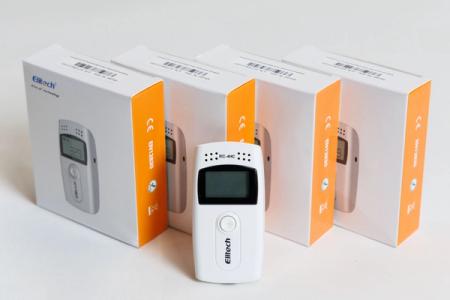
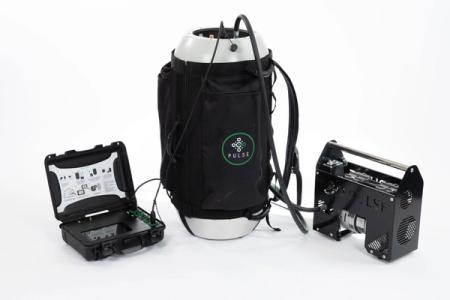
Our flagship products have been designed to be non-disruptive to both buildings and residents. SmartHTC is the most widely used HTC measurement tool in the world, while Pulse offers fast, accurate airtightness testing. The final product in the lineup is Heat3D for rapid U-value measurements.
This suite of products enable you to deeply understand what your building needs to enable it to perform as efficiently as possible, while ensuring the right measures are put in place for the greatest results.