What was the MEASURED project?
The MEASURED project demonstrated the value of using building performance measurement in heat pump design, it was part of the Department for Energy Security and Net Zero's Heat Pump Ready Programme. The project included:
- A field trial of more than 50 houses to compare heat pump sizing by building performance measurement, traditional survey and calculation
- Software development to create a heat loss calculation tool suitable for easy adoption by existing Domestic Energy Assessors and which can easily incorporate building performance measurements
- The creation of standardised measurement protocols to ensure consistent results across different building thermal performance (HTC) measurement providers
The project team brought together a leading building performance measurement provider, BTS, and leading building energy assessment provider Elmhurst Energy Consultancy.
Why did we do it?
Building performance measurement provides accurate heat loss assessment, bespoke to individual houses. By comparison, traditional heat loss calculations based on visual surveys are prone to inaccuracy as critical factors are hard or impossible to see:
- How much insulation in a cavity and how well installed?
- How airtight is the building?
- How much thermal bridging?
What were the results?
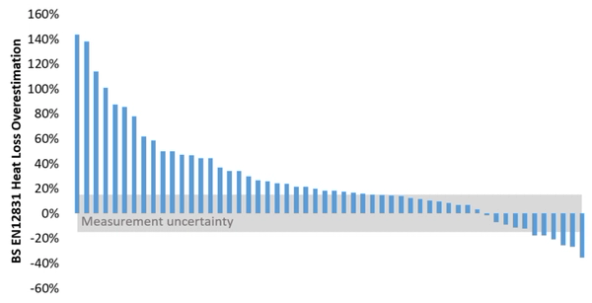
The average absolute difference between the calculated and measured heat loss was 35%, with a range of 36% undersized to 144% oversized. There was a significant bias towards overestimating the heat loss, with 59% of houses having an overestimate which would lead in turn to an oversized heat pump.
Larger heat pumps incur additional cost and disruption due to higher equipment costs, and the requirement for more upgrades to radiators and pipework. It's also more likely that an oversized heat pump will have lower running efficiency than one properly sized for the building. In this sample, the average oversizing was estimated to lead to an average additional cost of £2,100 per install. This average capital saving is many times more expensive than the cost of the measurement.
There were also 13% of houses for which the heat loss was undersized by a heat loss calculation; for these houses, there would be a risk that the specified heat pump wasn't sufficient to keep the house warm during the coldest periods.
What did householders & installers think?
Check out testimonials on the project YouTube page.
Where can I get any more detailed information?
Check out the project report.