Article
Can you prove your homes are performing better?
Why the Measure Up 2026 building performance measurement conference is worth stepping away from your desk for.
We can access more information than ever without leaving our desks. Webinars, LinkedIn, online meetings and industry publications make it easy to keep up with developments across the built environment.
But sometimes, being in the room matters.
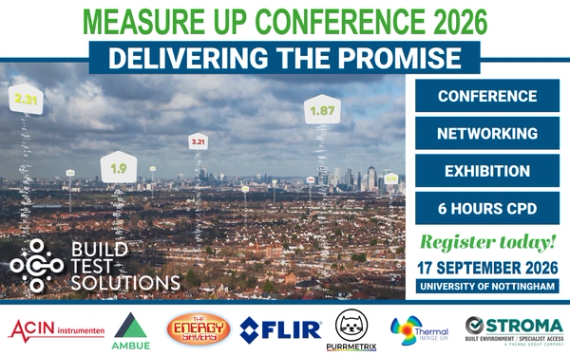
On 17 September at the University of Nottingham, Measure Up 2026: Delivering the Promise will bring together people from across housing, retrofit, construction and building performance to share knowledge, challenge thinking and discuss a fundamental question:
And increasingly, there's another important question:
For anyone responsible for delivering, owning or improving buildings, there are some compelling reasons to join us.
Better measurement can mean better use of money

Building performance measurement isn't just about collecting more data. Used effectively, it can help organisations spend money in the right places, rather than pushing budget into various "gaps", hoping it works.
For housing providers and building owners managing large portfolios, decisions about maintenance, retrofit and improvement programmes can involve significant investment. Yet without objective evidence of how buildings are actually performing, those decisions can sometimes be based on assumptions, models or incomplete information.
Measurement can help change that.
Understanding the real thermal performance of a building can help identify where improvements are genuinely needed, prioritise the properties likely to benefit most and provide evidence that completed work has delivered the expected result.
That creates opportunities to:
- Target investment more effectively, focusing budgets where they can have the greatest impact.
- Avoid unnecessary interventions where measurement shows performance is already better than assumed.
- Identify problems earlier, potentially reducing the cost of putting them right later.
- Validate completed work, providing confidence that money spent has delivered the intended outcome.
- Reduce the performance gap between what was designed or predicted and what is happening in reality.
- Build better evidence for future programmes, allowing investment decisions to improve over time.
At portfolio scale, even relatively small improvements in how investment is targeted can become significant.
The benefits extend to occupants too
Ultimately, buildings exist for the people who use them.
For occupants, poor building performance can translate into higher energy bills, uncomfortable temperatures, draughts and homes that are difficult or expensive to heat.
If we understand how a home actually performs, we have a much stronger basis for deciding what needs to change.
For housing providers, local authorities and landlords, that creates an opportunity to look beyond simply completing an improvement measure and ask a more useful question:
Did it actually make the home better?
A successful retrofit shouldn't only exist on a project spreadsheet. Ideally, its impact should be visible in improved thermal performance, greater comfort and potentially lower energy demand.
That matters particularly in social housing, where making the best possible use of investment can have a direct impact on residents.
Better evidence can help providers direct limited budgets towards measures and properties where they are likely to deliver the greatest benefit: creating potential savings for the organisation while helping occupants benefit from homes that cost less to keep comfortable.
Measurement can therefore create value on both sides of the front door.

Learn from people tackling the same challenges
The gap between predicted and actual building performance isn't an abstract problem.
Housing providers need to demonstrate that investment is improving homes. Local authorities need confidence that public money is delivering results. Retrofit professionals need to understand whether interventions have worked. Developers need to demonstrate quality. Architects and M&E consultants need feedback on how designs perform once they're built.
And increasingly, measurement provides the evidence.
Measure Up Conference 2026

This years conference brings these different perspectives together.
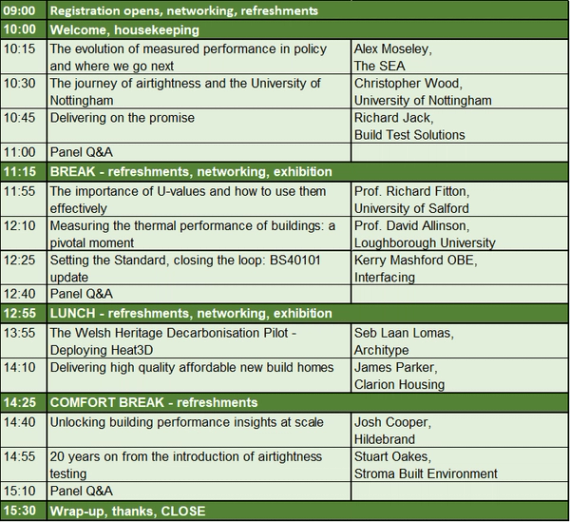
Our speakers come from organisations including Clarion Housing Group, the University of Nottingham, University of Salford, Loughborough University, Architype, Stroma Built Environment and The SEA, providing perspectives from research, policy and real-world delivery.
The agenda covers everything from airtightness and U-values to thermal performance, policy, BS40101, new-build housing and retrofit.
Rather than looking at building performance through a single lens, the conference gives attendees an opportunity to understand how these pieces fit together.
Move from 'we've done the work' to 'we know it worked'
One of the most important opportunities created by measurement is the ability to close the loop.
Traditionally, success can be measured by outputs: how many homes were retrofitted, how much insulation was installed or whether a project met its specification.
But completing work and achieving performance aren't necessarily the same thing.
Objective measurement provides an opportunity to verify the outcome.
For housing providers and asset owners, answering these questions can help protect investment. It can also provide valuable feedback to designers, contractors and delivery teams, helping improve the next project.
Over time, this creates a cycle of measure, learn, improve and verify, rather than simply assuming that specifying an intervention guarantees the desired result.
Take ideas back to your projects
A good conference shouldn't simply tell you what's happening in the industry. It should change what you do when you get back to work.
Throughout Measure Up, we'll explore how objective measurement can help organisations make better decisions.
That could mean identifying which homes should be prioritised for retrofit. It could mean verifying whether an intervention has delivered the expected improvement. It might be understanding why a new building isn't performing as designed, improving quality assurance or providing evidence to support investment decisions.
For retrofit assessors, M&E consultants, architects, building surveyors, snagging specialists, developers, housing providers and local authorities, the applications may be different, but the principle is the same:
Better evidence enables better decisions. And better decisions can save money.

See where policy and practice are heading
Expectations around building performance are changing.
The Warm Homes Plan, Future Homes Standard, Building Safety Act and wider retrofit agenda are placing increasing emphasis on better-performing buildings, healthier homes, consumer protection and value for investment.
The challenge is turning those ambitions into reality.
Measurement, testing and monitoring are therefore moving beyond specialist technical exercises and becoming increasingly valuable tools for those designing, delivering, managing and improving buildings.
Measure Up provides an opportunity to understand that changing landscape and consider what it means for your organisation before those changes become business as usual.
Have the conversations you don't get from a webinar
This is where in-person events really earn their place.
You might attend because of a particular speaker or session, but often the most useful conversation of the day happens over coffee.
It's the question you ask a speaker after their presentation.
The housing provider who has already encountered the problem you're trying to solve.
The consultant with a completely different perspective on your project.
The technology demonstration that suddenly makes an unfamiliar approach much easier to understand.
Or simply discovering that another organisation is wrestling with exactly the same challenge as you.
Those conversations are difficult to recreate online.
At an in-person event, ideas move beyond presentations. They're questioned, discussed and connected to real projects.

Build relationships, not just contacts
The built environment is an interconnected industry.
Delivering genuinely better buildings requires collaboration between designers, contractors, consultants, assessors, technology providers, asset managers, housing teams, policymakers and many others.
Bringing those groups together creates opportunities that don't necessarily happen through scheduled online meetings.
You can meet people outside your immediate professional circle, compare experiences and develop relationships that continue long after the event has finished.
That's particularly important as building performance becomes more multidisciplinary. Understanding how someone elsewhere in the delivery chain sees the same problem can be incredibly valuable.
Get away from the day-to-day
There's another benefit of attending an event that is easy to underestimate: time to think.
Most working days are dominated by emails, Teams calls, deadlines and immediate project demands.
Taking a day away creates space to look beyond the next task and consider bigger questions.
- Are we measuring the right things?
- Do we actually know whether our buildings perform?
- Are we spending money on the right properties and interventions?
- Could better evidence help reduce costs for both building owners and occupants?
- What can we learn from organisations already doing this?
Sometimes the value of a conference isn't a single answer. It's returning to work with better questions.
Who should attend Measure Up 2026?
Measure Up isn't only for building performance specialists.
If you have a role in designing, building, assessing, improving, commissioning, managing or investing in buildings, there will be something relevant to your work.
That includes:
- Social housing providers and local authorities
- Retrofit assessors and coordinators
- Architects and designers
- M&E and building services consultants
- Developers and housebuilders
- Building surveyors and snagging companies
- Energy assessors
- Contractors and consultants
- Asset and sustainability teams
- Policymakers and researchers
Different disciplines may approach building performance from different directions, but ultimately we're working towards the same outcome: buildings that perform better for the people who use them, while making smarter use of the money available to improve them.
Join the conversation
Measure Up 2026: Proving the Promise takes place on Thursday 17 September 2026 at the University of Nottingham.
It's a day to learn from experts, discover how measurement is being applied in the real world, meet organisations developing the technology, compare experiences with your peers and make connections across the industry.
For housing providers and owners in particular, it's an opportunity to consider building performance measurement not simply as another cost or compliance exercise, but as a way to reduce uncertainty, protect investment, target spending and demonstrate value.
And for occupants, better-informed decisions have the potential to mean something much more tangible: warmer, more comfortable homes that require less energy to heat.
Because improving building performance requires more than targets and predictions.
Better buildings shouldn't just be promised. They should be proven.
Find out more and sign up today